
 Photo: Rsparks3, CC0
Home batteries
Wall-mounted in the garage, with a disconnect. Silent and automatic: the lights stay on.
Battery backup
Photo: Rsparks3, CC0By the numbers
13.5 kWh
In one typical home battery: about a day of essentials with one room cooled
Tesla Powerwall 3 class
30 kWh
What central air can use on a hot Florida day
About 3 kW for 10 hours
100+ kWh
In a large electric truck’s battery, several home batteries’ worth
Ford, GM and Tesla specs
$0
Federal tax credit for home batteries installed after 2025
IRS residential clean energy credit
Your sizing plan
A first sizing, not a design. We confirm loads, surge and placement at your home. Typical Florida installed prices, November 2026, before any incentive: first battery $13,000–$17,000, each added battery $9,000–$12,000.
Your options
| Typical cost | Runs for | Good to know | |
|---|---|---|---|
| Generator inlet and interlock | $1,200–$2,500 plus a portable generator ($900–$3,000) | As long as you have fuel | Lowest cost. Manual, noisy, and the generator must run outside, away from windows |
| Vehicle-to-home (V2H) | $5,000–$9,000 for the bidirectional equipment and install | Days, from a big EV battery | Only with listed EVs and the maker’s equipment |
| Home battery | $13,000–$17,000 for the first | About a day of essentials each | Silent, automatic, no fuel. Add solar to recharge |
| Solar plus battery | Varies with the system | Days, recharging every sunny day | The longest quiet backup; needs the utility’s approval |
| Standby generator | $12,000–$20,000 | Days, on natural gas or propane | Whole home, automatic; needs a gas supply and yearly service |
See it
Photo: Rsparks3, CC0Home batteries
Wall-mounted in the garage, with a disconnect. Silent and automatic: the lights stay on.
 Photo: Pokemonprime, CC BY 4.0
Your EV as backup
A large truck battery holds several home batteries’ worth, with the maker’s bidirectional charger.
 Photo: U.S. Consumer Product Safety Commission, Public domain
Portable generator, safely
Outside, far from doors and windows, plugged into an inlet with an interlock, never a dryer outlet.
 Photo: Rsparks3, CC0
Smart panels
Choose which circuits stay on and stretch a battery further.
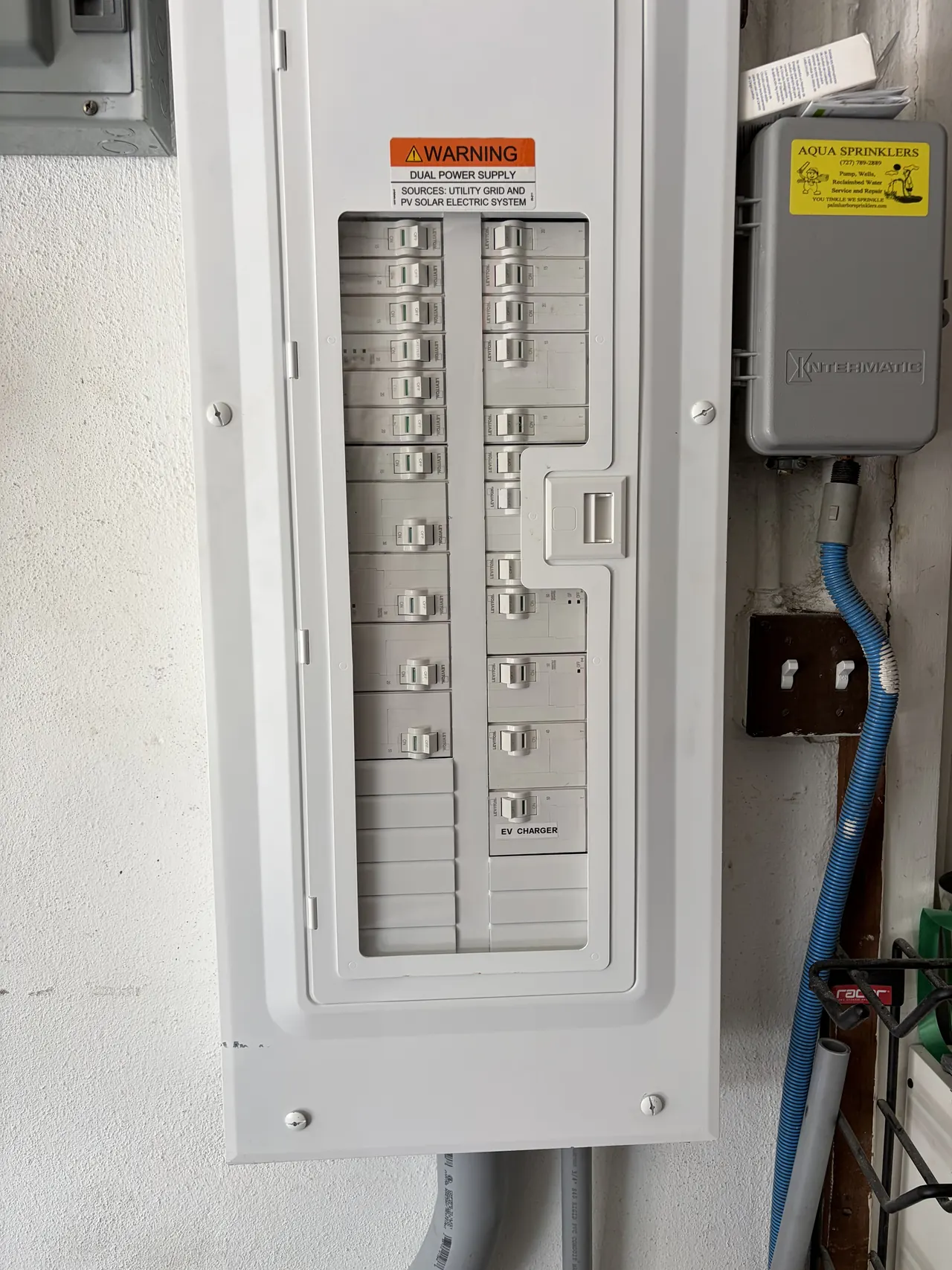
Labeled for solar and backup
Every power source labeled at the panel, as code and the inspector require.
 Photo: TaurusEmerald, CC BY-SA 4.0
Inverter generators
Quieter, cleaner power for electronics, sized to your essentials.
Bidirectional charging
Vehicle-to-home (V2H)
The car powers the house through a bidirectional charger and transfer equipment, automatically when the grid goes down. Ford, GM, Tesla (Cybertruck) and Kia sell their own systems for listed models.
Vehicle-to-load (V2L)
Outlets on or from the car run a fridge or tools through extension cords. Useful, but not a way to power the house wiring.
Never back-feed a house through a dryer outlet or with a “suicide cord.” It can electrocute utility workers and start fires. Any backup tied to your panel needs a transfer switch or interlock and a permit.
Buying a battery
Energy (kWh)
How long it lasts. 13.5 kWh runs essentials for about a day.
Power (kW) and surge
What it can run at once. Air conditioners and well pumps need surge power to start.
Whole home or essentials
A smart panel or a backup panel decides what stays on.
Warranty
Look for 10 years or more and the capacity it guarantees at the end, often 70%.
Chemistry and heat
LFP batteries handle heat well and last more cycles. Check the outdoor and temperature ratings.
Flood and storm placement
Mounted above flood level and anchored, with clearances the maker requires.
Brands
| Capacity | Power | Warranty | Good for | |
|---|---|---|---|---|
| Tesla Powerwall 3 | 13.5 kWh | 11.5 kW | 10 years | Most homes; solar built in |
| Enphase IQ Battery 5P | 5 kWh each, stackable | 3.84 kW each | 15 years | Enphase solar homes; small steps |
| FranklinWH, SolarEdge, Generac | Varies | Varies | 10+ years | Whole-home and solar systems |
| Standby generators (Generac, Kohler) | Fuel-limited | 10–26 kW | 5–10 years | Central air for days |
Specs from each maker, November 2026; models change. We recommend the system that fits your loads and budget, not a brand.
How we do it
Plan
We list what you need to keep running, check your panel and pick the right size and spot.
Design and permit
Our engineers draw it and our permit team files it, plus the utility’s approval when solar is involved.
Install
Battery, inlet, transfer equipment or generator, labeled at the panel.
Inspect and test
We meet the inspector and test a real outage: the house switches over.
Show you
How to read the app, what stays on and how to stretch it in a long outage.
Questions
It depends on what you run. One 13.5 kWh battery runs a fridge, lights, Wi-Fi, fans and one room of cooling for about a day; central air uses about 30 kWh on a hot day, so it needs several batteries or solar to recharge them. The calculator sizes it for you.
Yes, if the battery can deliver the power and the energy. A soft-start kit lowers the surge when the compressor starts. Running it for days usually means several batteries with solar, or a standby generator.
Batteries are silent, automatic and run indoors or out with no fuel or fumes, but cost more per day of backup. Generators run as long as you have fuel, but need maintenance and must run outside, away from windows. A portable generator with an inlet and interlock is the lowest-cost option.
Some EVs can power your home during an outage through bidirectional equipment: Ford, GM, Tesla (Cybertruck) and Kia each sell their own. A big EV battery holds as much as several home batteries.
No. The residential clean energy credit ended for systems installed after December 31, 2025. Ask your tax professional about anything else that may apply.
Yes. Batteries, generators, inlets and transfer equipment all need an electrical permit and inspection in Florida, and batteries tied to solar also need the utility’s approval. We handle both.
Usually on a garage or outside wall, above the flood level, out of direct sun where possible and within the maker’s clearances. We plan placement around your flood zone.
Tell us which circuits matter and we’ll design around them.